
Technical Approach
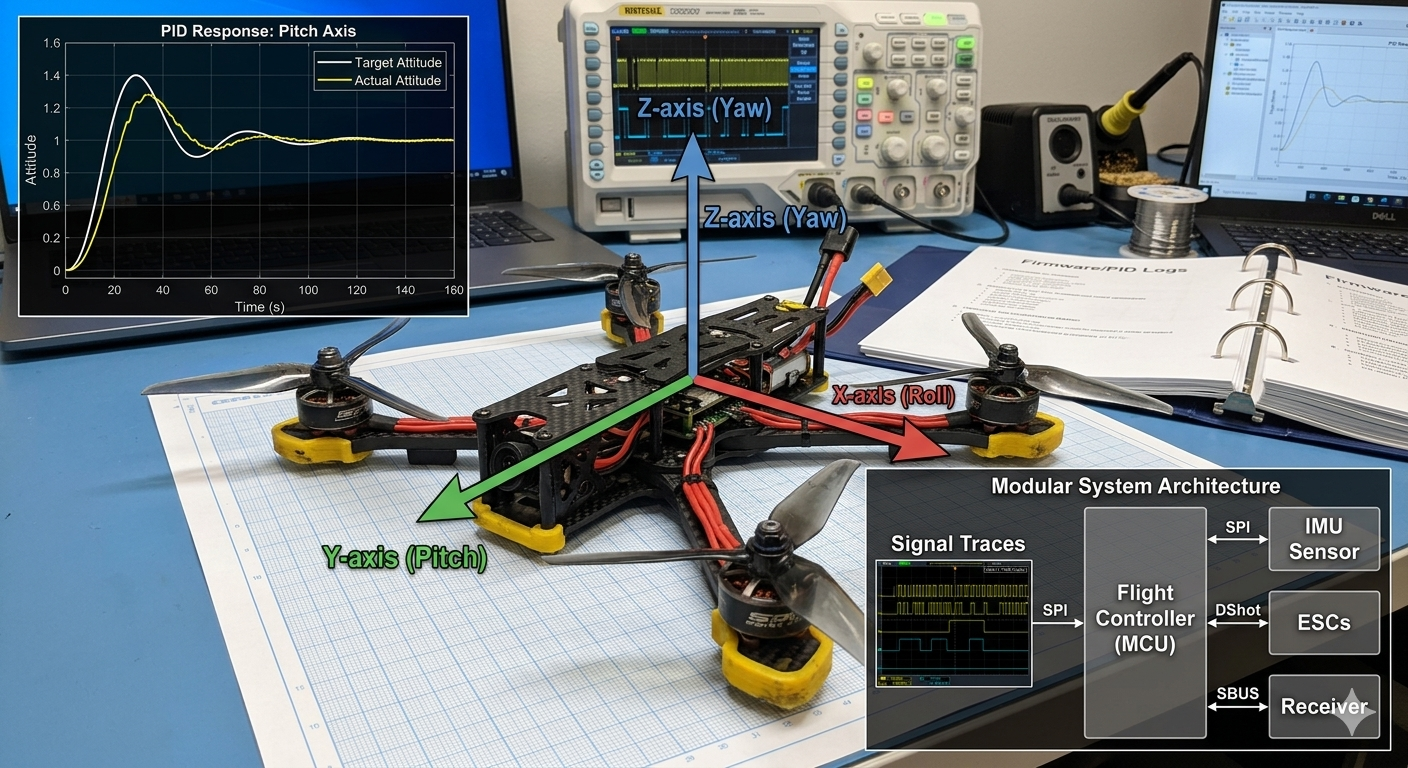
Bench-level system view showing body-axis orientation, PID response context, and the modular flight stack architecture.
System architecture
The FCS uses a hierarchical control structure:
- outer loop handles position and altitude targets
- middle loop manages roll, pitch, and yaw attitude
- inner loop performs motor mixing and PWM generation
All loops run on the Teensy 4.1 at defined frequencies chosen to balance control responsiveness and implementation stability.
Flight computer
The Teensy 4.1 was selected because it offers:
- 600 MHz ARM Cortex-M7 performance
- rich SPI, I2C, and UART peripheral support
- a compact form factor suitable for flight hardware
- enough compute headroom for sensing, estimation, control, and logging
Control strategy
The initial controller is cascaded PID.
| Loop | Input | Output | Target frequency |
|---|---|---|---|
| Roll PID | Roll angle error | Differential motor thrust | 500 Hz |
| Pitch PID | Pitch angle error | Differential motor thrust | 500 Hz |
| Yaw PID | Yaw rate error | Counter-torque adjustment | 500 Hz |
| Altitude hold | Barometer altitude error | Collective thrust | 100 Hz |
Implementation notes
- apply derivative to measurement instead of error to reduce derivative kick
- clamp integral state to prevent windup
- clamp final output to the valid motor command range
- target a 500 Hz main control loop on the Teensy 4.1
Sensors and interfaces
- IMU over I2C for angular rate and acceleration
- barometer over I2C or SPI for altitude hold
- RC receiver over SBUS or PPM
- ESC outputs over PWM initially, with DSHOT as a future improvement if hardware compatibility is confirmed
- SD logging for repeatable flight data analysis
Development stack
| Layer | Tooling |
|---|---|
| Firmware | PlatformIO with Arduino framework |
| Analysis | Python with matplotlib, pandas, and scipy |
| Simulation | Python or MATLAB/Simulink |
| Version control | Git and GitHub |
Theory background
The platform is intentionally designed to teach and validate:
- rigid-body quadcopter dynamics
- coordinate frames and attitude representation
- sensor fusion through a complementary filter
- cascaded PID control and tuning
- experimental validation from bench tests through flight tests